
The Legal Illegals
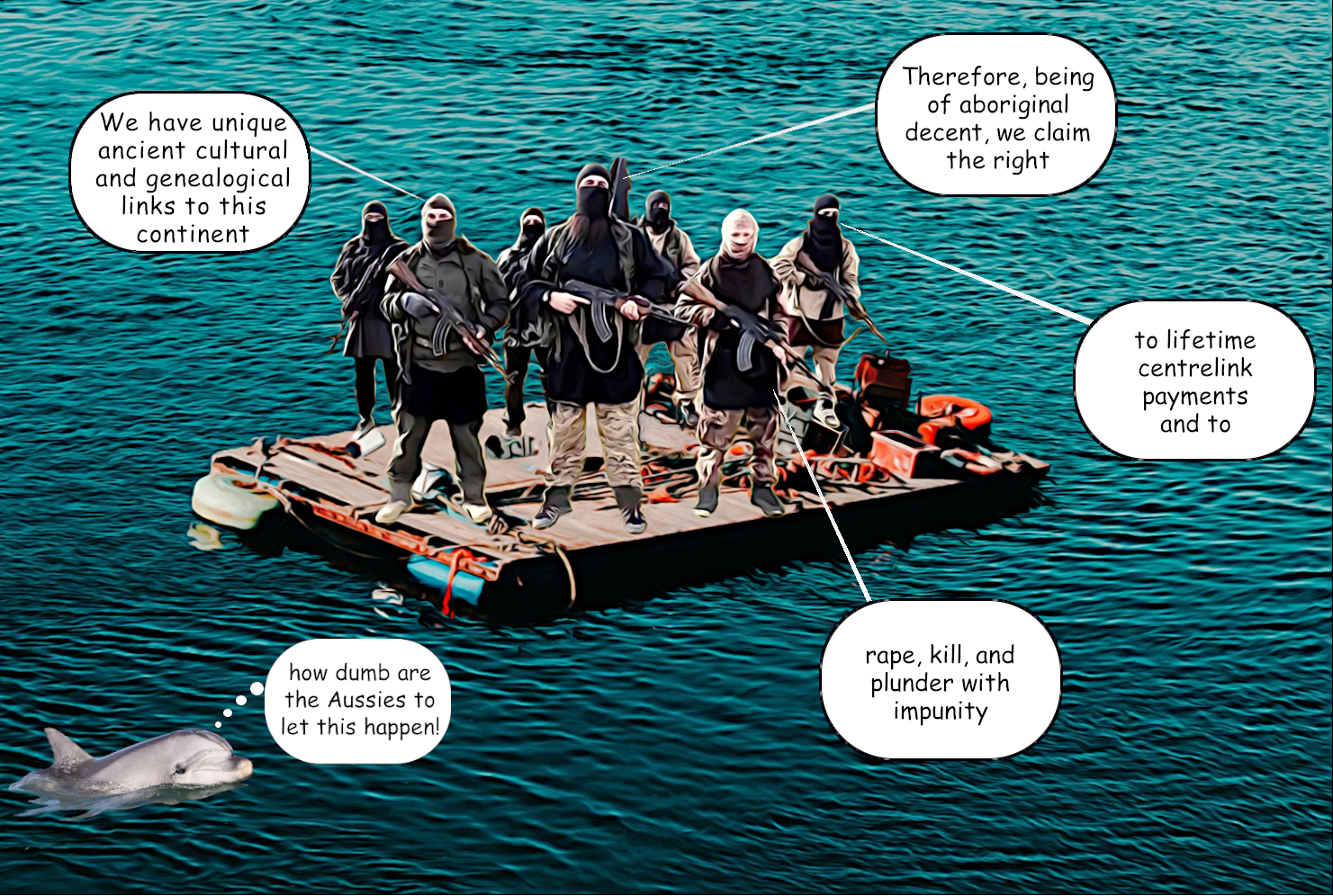
The High Court of Australia recently ‘enacted’ a highly questionable exception to the constitution based entirely on race. It confers special privileges to two men who claim aboriginal decent and thereby excludes them from the normal application of the laws pertaining to non-citizens. There now exists “an implication” to treat some people differently from the rest of the legally recognised population.
The implications are broad and profound. The high court has now assumed the power to replace the law with invested perceptions of morality and injustice. The court argued that the common law must be taken to have recognised that Aboriginal persons ‘belong’ to the land. In defining Aboriginal people, in tackling our standing in the Constitution, in legislation and in our everyday enjoyment of civil rights, the notion of “race” must be replaced by a more concise conception of peoples with unique and ancient cultural and genealogical links to this continent.
As noted by one writer, “four judges created new law, undermined the rule of law, altered the words of the Constitution, snubbed the power of parliament and appointed themselves philosopher kings in our democracy”.
A three-part definition of an Aboriginal person lies at the core of the decision made by the High Court. He or she must:
- be descended from an Aboriginal person
- must identify as Aboriginal, and
- be recognised by his or her community as such.
Whilst the court avoided declaring a factual definition of aboriginality, it instead found: “If the commonwealth did not accept Mr Love’s pleaded case, that he is a member of the Aboriginal race of Australia, the appropriate course was for the proceeding to have been remitted to the Federal Court of Australia for the facts to be found”. Putting aside this factor, its discussions revolved around the definitions that were declared in the Tasmanian and Mabo cases.
Justice Virginia Bell, one of the four judges in the majority, noted: “Whether a person is an Aboriginal Australian is a question of fact.” She went on to point to the origins of the three-part definition of aboriginality in the Tasmanian dam case in which Justice William Deane proposed the meaning of the term “Australian Aboriginal” as “a person of Aboriginal descent, albeit mixed, who identifies himself as such and who is recognised by the Aboriginal community as an Aboriginal”. Deane favoured the view that the reference was to the “Australian Aboriginal people generally rather than to any particular racial sub-group”.
The submissions relied on Justice Gerard Brennan’s formulation in Mabo (No 2) for the meaning of “Aboriginal” Australian: “(m)embership of the indigenous people depends on biological descent from the indigenous people and on mutual recognition of a particular person’s membership by that person and by the elders or other persons enjoying traditional authority among those people.”
Here we can discern a shift from a cultural interpretation of an indigenous polity in the Tasmanian case to a biological one in the Mabo case. This (mis)interpretation points to: an increasing confusion over the notion of race; the colonial racialisation of hundreds of Aboriginal peoples as a single race; and, the concerning alignment to a eugenicist view of humanity, even from the most educated.
The High Court judges ruled that Australia’s citizenship laws as applied to an individual is dependent upon their racial background and identity. Although not born in Australia and not Australian citizens, they could not be deported following their criminal convictions because as people of indigenous descent they were not “aliens” under the terms of the constitution. This ruling raises three potentially significant consequences:
- First, it overturns the notion of equality before the law.
- Second, the decision means the Parliament no longer has the capacity to decide who can and cannot reside in the country as there now exists a class of people beyond the realm of Commonwealth law.
- Third, the reasons provided by the majority for their extraordinary decision are confused and incoherent, and are grounded in politics and philosophy, not in law. “It concedes to a non-constitutional non-representative non-legally-accountable sub-national group a constitutional capacity greater than that conferred on any state parliament”.
The practical effect is that although this newly defined group of people owe no duty or allegiance to Australia, they are able to impose themselves on Australia by reason of Australia’s inability to deport them.
The immediate reality is that it sets indigenous Australians apart. Inequality under the law has become embedded into our founding document. Moreover, by implication, the country’s highest court has held out a carrot to lawyers across the country to ask other courts to approve as yet unknown special race-based exceptions.
Update 2nd March 2020 (The Australian):
Home Affairs officials are examining claims 23 immigration detainees should be released because they are indigenous.
The cases have come to light after the High Court ruled Aboriginal and Torres Strait Islander people born overseas could not be deported for committing serious crimes.
Home Affairs lawyer Pip de Veau said the department was aware of most cases before the High Court ruling last month, but some detainees had identified as indigenous since the decision.
“Negotiations are ongoing to establish evidence in a number of matters,” Ms de Veau told a Senate estimates hearing.
One indigenous person was released from immigration detention last week.
“I can advise that one person clearly met the (indigeneity) test to the satisfaction of one of my officers and they were released during the course of last week,” Home Affairs secretary Mike Pezzullo told the committee.
Mr Pezzullo said if detainees proved they were indigenous, Home Affairs could not keep them locked up.
Comments
The Legal Illegals — No Comments
HTML tags allowed in your comment: <a href="" title=""> <abbr title=""> <acronym title=""> <b> <blockquote cite=""> <cite> <code> <del datetime=""> <em> <i> <q cite=""> <s> <strike> <strong>