
Australia can save the world
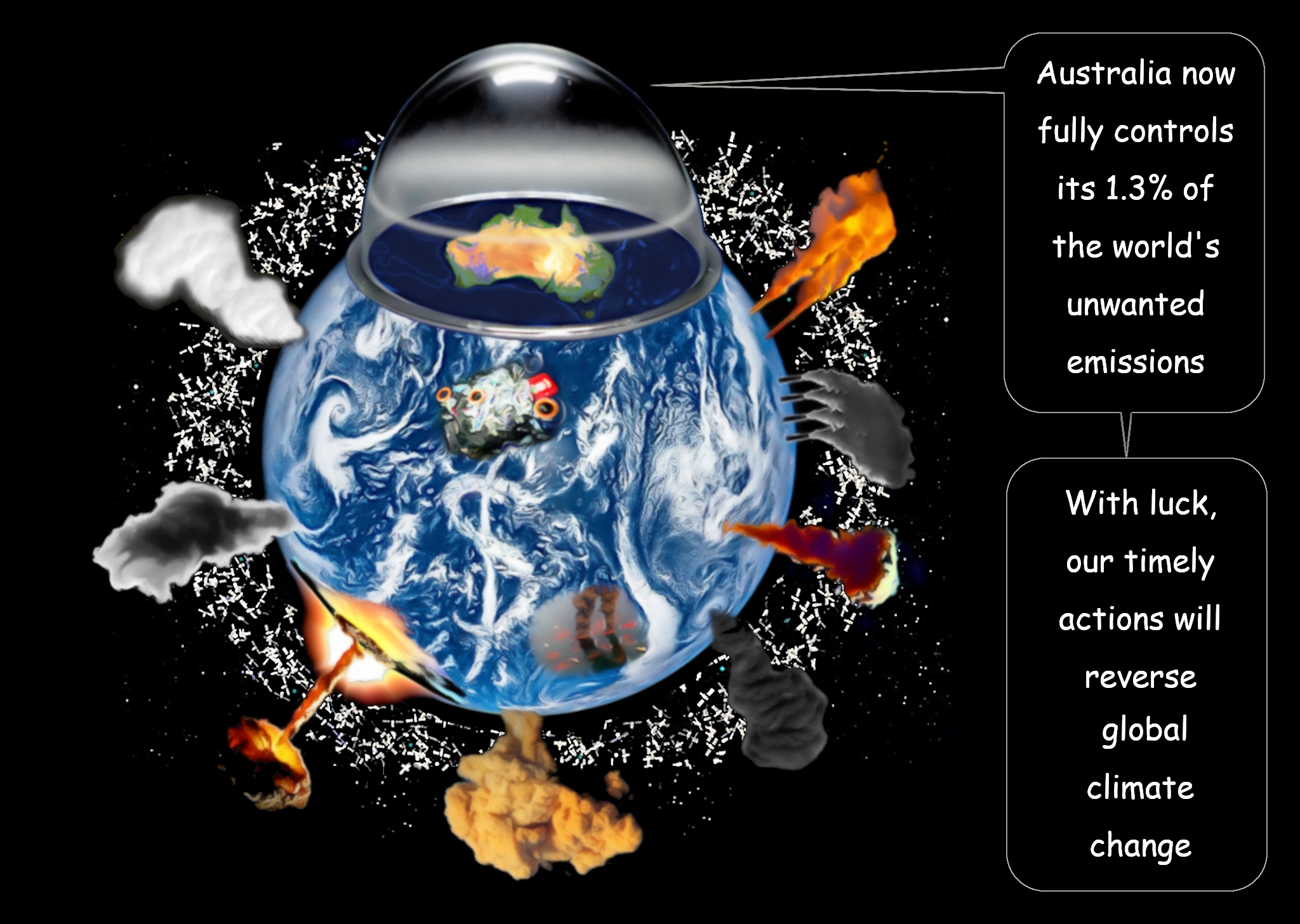
[click on image to enlarge – 2 levels]
Australia produces 1.3% of the world’s emissions. Despite this low level, we are being severely criticised for not doing enough to reduce the per capita rate, which depending on the data source, varies from 1st in the world rankings to 15th.
Source: https://www.ucsusa.org/resources/each-countrys-share-co2-emissions
The recent widespread fires across the country have added further fuel (pun intended) to the claim that the fires are primarily caused by climate change and that Australia is now paying the price for not doing enough to reduce its carbon emissions. World wide protests are currently calling for our prime minister to do more or be sacked.
The argument put forward by greenie inc that the windows of opportunity to reduce fuel loads have diminished due to increasing temperatures does not mitigate the fact that their policies and pressures over the past decades have allowed fuel loads to increase well past manageable levels even if workable opportunities arose.
See: https://www.dpaw.wa.gov.au/management/fire/fire-and-the-environment/51-fuel-loads-and-fire-intensity
The cartoon raises the question “what would really happen even if we reduced our emission % to zero (0)?” A carefull look at the cloud formations (and in between) point to factors other than emissions that are far beyond Australia’s capacity to resolve.
Update 30th June 2021:
Extracted without amendment from Minding the Campus written by By Daniel Nebert June 29, 2021.
Skeptics know that, since Earth was formed more than 4.5 billion years ago, it has always undergone “climate change,” i.e., variations in regional weather measured in decades or centuries. This is not to be confused with “weather changes—measured in days, weeks, and months.” Based on ice-core data, climate is cyclical. More than a dozen cycles of varying lengths have been identified by climate scientists; this means there are cycles within cycles within cycles.
Examples of climate change include Milankovitch’s Glacial-Interglacial Cycles occur every 110,000-120,000 years; Precession Cycles (every ~26,000 years); Lunar Tidal Cycles (1,800 years); Sixty-Year Climate Cycles (e.g., the 1930s-40s and 1980s-90s were both warm, but the former was warmer than the latter); Solar Cycles (varying sunspot activity every 11-12 years); and the El Niño-Southern Oscillation (ENSO)—El Niño and its opposite La Niña occurring every 2-7 years).
Skeptics know that before thermometers were invented (1714), Earth experienced: The Minoan Warm Period (~1500-1000 BC); The Roman Warm Period (~250 BC-400 AD); and The Medieval Warm Period (~950-1250 AD). During the latter, Vikings colonized southwestern Greenland; grape-growing and wine-making occurred in England and even near Stockholm. This last warm period was followed by the Little Ice Age (~1550-1850), during which time the Thames River sometimes froze over.
What are the natural causes of these cycles? Solar activity; radiative forcing and insolation (amount of sunlight absorbed vs amount radiated back into space); cloud type and amount; Earth’s rotation and interplay between its atmosphere and oceans; variations in precession, eccentricity and axial tilt of our planet; gravitational pull of other planets of substantial mass (especially Jupiter); and volcanic eruptions both on land and underwater.
Here is the dilemma: believers think that, since the Industrial Revolution began (1760), a human-caused rise in CO2levels is the source of “global warming” (aka “climate change”). This is their religion based on “soft” science. Skepticsagree that recent global warming has occurred; however, this reflects natural causes of climate cycles. Skeptics also agree that rising CO2 is occurring, in part by the Industrial Revolution, but that this is beneficial to plant growth. Doesn’t anyone—from grade-school biology—remember that plant photosynthesis involves the taking in CO2 while expelling O2, whereas all animals inhale O2 and exhale CO2? Life on this planet is carbon-based—these data represent “hard” science.
Skeptics also know that, in past ages, geological data suggest CO2 levels have been as high as ~10,000-15,000 parts-per-million (ppm). This was before mammals evolved, and plant life flourished. In recent times, “normal” CO2 has ranged between ~150-180 ppm during Glacial Periods and ~280-310 ppm during Inter-Glacial Periods. Earth came out of its last Glacial Period ~11,500 years ago.
Today’s global atmospheric CO2 levels are ~415 ppm. At these CO2 levels, plants are still currently “at least 25% CO2-starved.” In fact, commercial greenhouse growers commonly elevate CO2 to 800-1200 ppm; this enhances growth and yield by ~20-50%. Indoor air routinely ranges between 500 and 2,000 ppm of CO2. Submarines regularly operate with ambient CO2 levels between 2,000 and 5,000 ppm.
The atmospheric effect of CO2 on climate is highly exaggerated. Since the end of the Little Ice Age (1850), our planet has been warming naturally (thankfully)! Industrialization during the past 2½ centuries has perhaps increased global atmospheric CO2 levels by ~100 ppm, which has improved crop growth.
As planetary temperatures rise, skeptics know that CO2 in the liquid phase (oceans) moves to the gaseous phase (air)—we learn this in introductory chemistry. Hence, rising global atmospheric temperatures cause CO2 to increase, not the other way around.
CO2 levels in our lungs reach ~40,000-50,000 ppm, which causes us to inhale our next breath. One of the first things medical students learn in respiratory physiology is that the carotid body (clusters of chemoreceptor cells located in the neck) detects changes in arterial blood flow pO2 (partial pressure of oxygen), pCO2, blood pH, and temperature. When the blood pCO2 reaches a critical level, the carotid body quickly sends this message to the brainstem, which then sends signals to the diaphragm to breathe. The body needs more O2, and therefore exhales the excess CO2.
“Carbon emissions” and “carbon footprint” as causes of “global warming” are nothing more than scaremongering buzzwords created by global warming alarmists, insincere environmentalists, certain dishonest politicians and “scientists” who need their salary, misinformed journalists, and “environmental economists.”
Skeptics know that CO2 is an odorless, tasteless, invisible, non-polluting gas on which all life on Earth depends. “Smoke” from factory chimneys represents mostly water vapor, not CO2 (a common error in the media every day). Dirty industrial fossil-fuel pollution is, of course, undesirable and causes health problems. However, many scientific lines of evidence—including geological history and fundamental radiation-transfer physics—show that human-made CO2 emissions have a negligible influence on climate in comparison to the natural factors listed above.
Comments
Australia can save the world — No Comments
HTML tags allowed in your comment: <a href="" title=""> <abbr title=""> <acronym title=""> <b> <blockquote cite=""> <cite> <code> <del datetime=""> <em> <i> <q cite=""> <s> <strike> <strong>